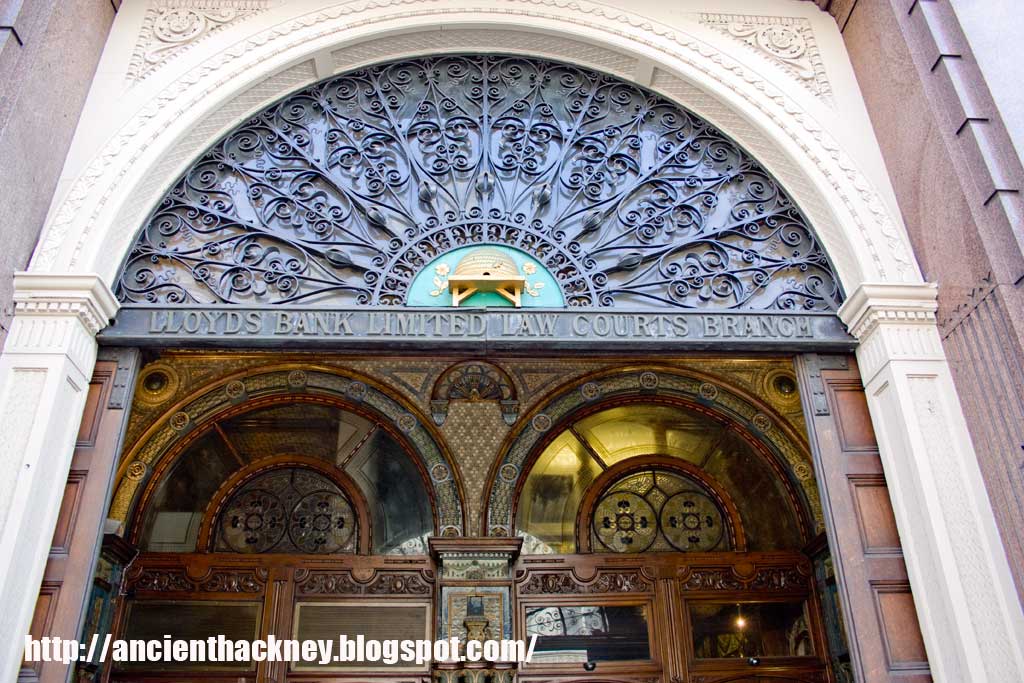
This great hall is normally kept private for members only but on Open House weekend...
Here's what Wiki says;
The Honourable Society of the Middle Temple, commonly known as Middle Temple, is one of the four Inns of Court exclusively entitled to call their members to the English Bar as barristers; the others being the Inner Temple, Gray's Inn and Lincoln's Inn. It is located in the wider Temple area of London, near the Royal Courts of Justice, and within the City of London.
In the 13th century, the Inns of Court originated as hostels and schools for student lawyers. The Middle Temple is the western part of "The Temple", the headquarters of the Knights Templar until they were dissolved in 1312; the awe-inspiring Temple Church still stands as a "peculiar" (extra-diocesan) church of the Inner and Middle Temples. There has never been an "Outer Temple", apart from a Victorian-era office block of that name: an order of 1337 mentions the "lane through the middle of the Court of the Temple", used by chancery justices and clerks on their way to Westminster, which became known as Middle Temple Lane and probably gave its name to the Inn. The Inns stopped being responsible for legal education in 1852, although they continue to provide training in areas such as advocacy and ethics for students, pupil barristers and newly-qualified barristers. Most of the Inn is occupied by barristers' offices, known as "chambers". One of the Middle Temple's main functions now is to provide education and support for new members to the profession. This is done through advocacy training, the provision of scholarships (£1 million in 2005), subsidised accommodation both in the Temple and in Clapham, and by providing events where junior members may meet their more senior colleagues for help and advice.
Middle Temple Hall is at the heart of the Inn, and the Inn's student barristers are required to attend a minimum of 12 qualifying sessions there. Qualifying sessions, formerly known as "dinners", combine collegiate and educational elements and will usually combine a dinner or reception with lectures, debates, mooting, or musical performances. Middle Temple Hall is also a popular venue for banqueting, weddings, receptions and parties. In recent years it has become a much-used film location - the cobbled streets, historic buildings and gas lighting give it a unique atmosphere. Shakespeare's Twelfth Night received its first recorded performance here, at the feast Candlemas in 1602.
wiki: http://en.wikipedia.org/wiki/Middle_Temple
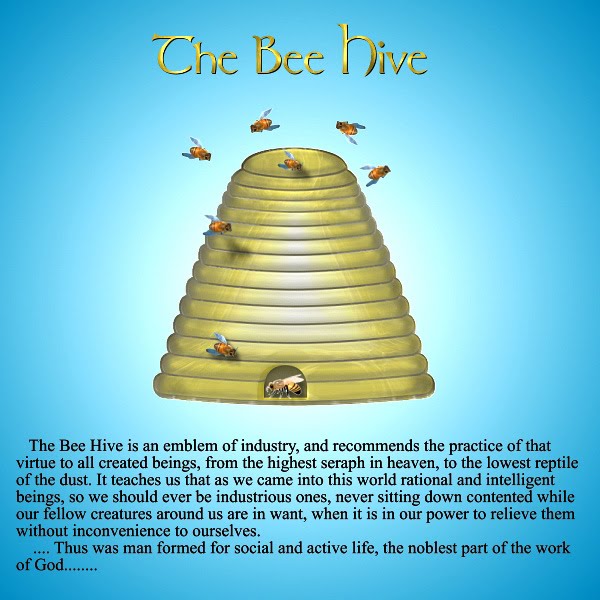
The bee and the hive have long been symbols of industry and regeneration, wisdom and obedience, with a place in Egyptian, Roman and Christian symbolism. The hive is often seen in Masonic illustrations of the 18th and 19th century and both Clovis and Napoleon adopted the bee as their symbol. Although "the bee was among the Egyptians the symbol of an obedient people, because, says Horapollo, 'of all insects, the bee alone had a king.'1, its use in Freemasonry was secondary to any number of other symbols based on the working tools of a stone mason.


"Honey is used to illustrate moral teachings. A man is exhorted to eat honey and the honey comb (Pr 24/13), but warned against surfeit (Pr 25/16.27). It was a simile for moral sweetness (Ezk 3/3), and for the excellence of the law (Ps 19/10), of pleasant words (Pr 16/24), and of the lips (Ca 4/11), and as a figure of love (Ca 5/1). The LXX adds to Pr 6/8 'Go to the bee, and learn how diligent she is, and what a noble work she produces; whose labour kings and private men use for their health. She is desired and honoured by all, and, though weak in strength, yet since she values wisdom she prevails.' This quote exists in the Arabic version, and is quoted by ancient writers." 3. That the newly converted Clovis would use a bee as his symbol is not surprising. It aligned him with the Christian Roman Empire without alienating those of his subjects who still maintained non-trinitarian or pagan sympathies.

Napoleon was initiated, passed and raised into an Army Philadelphe Lodge of the Ecossais Primitive Rite of Narbonne between 1795 and 1798.4. Considering Napoleon’s interest in things Egyptian, his reason for adoption of the bee symbol can only be a subject of supposition. When Napoleon had embroidered bees sewn on his robes it was not as a claim of legitimacy directed at any of his contemporaries; certainly not the aristocracy whose roots were not Merovingian nor sympathies masonic. Certainly not the freemason revolutionaries of the USA who were then embracing republicanism. The bee is a symbol of systematized industry, an obedient people and of rebirth. It is easier to accept that the Merovingians, freemasons and Napoleon found their way to the symbol by their own path than it is to create a convulated and undocumented connection between them as some conspiracy theorists have tried.


"The bee hive is an emblem of industry, and recommends the practice of that virtue of all created beings, from the highest sereph in heaven, to the lowest reptile of the dust. It teaches us, that as we came into the world rational and intelligent beings, so we should ever be industrious ones; never sitting down contented while our fellow-creatures around us are in want, when it is in our power to relieve them, without inconvenience to ourselves.

Temple Bar
Hackney

The Scottish Rite is one of the appendant bodies of Freemasonry that a Master Mason may join for further exposure to the principles of Freemasonry. In England and some other countries, while the Scottish Rite is not accorded official recognition by the Grand Lodge, there is no prohibition against a Freemason electing to join it. In the United States, however, the Scottish Rite is officially recognized by Grand Lodges as an extension of the degrees of Freemasonry. The Scottish Rite builds upon the ethical teachings and philosophy offered in the craft lodge, or Blue Lodge, through dramatic presentation of the individual degrees. There are records of lodges conferring the degree of "Scots Master" or "Scotch Master" as early as 1733. A lodge at Temple Bar in London is the earliest such lodge on record. Other lodges include a lodge at Bath in 1735, and the French lodge, St. George de l'Observance No. 49 at Covent Garden in 1736. The references to these few occasions indicate that these were special meetings held for the purpose of performing unusual ceremonies, probably by visiting Freemasons.